
Higher education is changing quickly. Students now use digital tools for research, presentations, coding, design, communication, collaboration, and everyday study. Universities also need technology that is easy to manage, secure, flexible, and useful across many subjects. This is where Apple higher education solutions can become relevant.
Apple supports colleges and universities with Mac, iPad, learning resources, professional learning, deployment tools, and education-focused services. Its higher education offering is designed for students, faculty, staff, and IT teams, with an emphasis on productivity, creativity, security, and long-term learning.
This guide explains what Apple higher education means, how Apple devices can support university work, what students and teachers can use them for, and what to consider before choosing Apple technology for an academic environment.
What Is Apple Higher Education?
Apple higher education refers to Apple’s technology, services, resources, and education programs designed for colleges and universities. The offering covers more than buying a Mac or iPad. It can include devices, apps, professional learning, device management, deployment support, education pricing, and resources for teaching and learning.
Apple’s official higher education page highlights Mac, creative tools, professional learning, streamlined deployment, and campus-ready apps. It also describes support for faculty, students, leaders, and IT teams.
In simple terms, Apple higher education is about using Apple technology as part of the wider university learning environment.
Why Apple Technology Matters in Higher Education
University students often move between lectures, libraries, labs, group projects, online research, presentations, and independent study. They may need one device to handle several different types of work.
Apple higher education can support these different activities by combining hardware and software in one ecosystem. A student studying business may use a Mac for research and presentations, while a design student may need creative applications. A computer science student can use development tools, while a teacher may use an iPad to explain ideas during a class.
The important point is that technology should support the academic task rather than create unnecessary complexity.
7 Powerful Benefits of Apple Higher Education
1. Strong Support for Student Productivity
Apple higher education tools can help students organize coursework, write assignments, create presentations, manage files, communicate with classmates, and complete research.
Mac computers are available in different configurations, allowing students and institutions to select devices based on their workload. Apple also promotes long-lasting performance and built-in tools for academic work.
For beginners, the biggest benefit is often having a consistent workflow. Students can use familiar apps and services for notes, documents, calendars, communication, and project work.
2. Creative Learning Across Different Subjects
Higher education is not limited to writing essays. Students may need to edit video, create graphics, record audio, build presentations, design prototypes, analyze information, or develop apps.
Apple higher education supports creative workflows through Mac and iPad tools. Apple’s higher education resources mention apps and tools such as Notes, Apple Pencil, Camera, and Apple Creator Studio, while its campus app collection includes products such as Goodnotes, Kahoot!, Canva, Procreate, Notability, and Adobe Photoshop.
This can make technology useful for both traditional academic work and project-based learning.
3. Helpful Tools for Faculty and Teachers
Teachers need technology for lesson preparation, presentations, communication, assessment, collaboration, and professional development.
Apple higher education includes professional learning resources for faculty. Apple says its Education Community provides learning resources, tutorials, and a forum for educators, while Apple Learning Coach is a free professional learning program aimed at instructional coaches and digital learning specialists.
For a university, this means the value of technology is not only measured by the device itself. Training and ongoing support can also affect how successfully technology is used.
4. Privacy and Security Features
Universities handle a large amount of information, including student records, research data, staff documents, and account details. Security is therefore an important consideration when selecting technology.
Apple says its education products include privacy features and controls, with a focus on limiting data collection, on-device processing where possible, and transparency around shared information.
Apple higher education can therefore be considered as part of a broader technology strategy where privacy, account management, device security, and responsible data handling all matter.
Institutions should still configure devices correctly, train users, maintain accounts securely, and follow their own data protection policies.
5. Easier Device Management for Institutions
Managing technology across a university can be difficult when hundreds or thousands of devices are involved. IT teams need ways to configure, deploy, update, and manage devices efficiently.
Apple higher education includes Apple School Manager and deployment resources designed to help organizations prepare and manage Apple devices. Apple Support describes Apple School Manager as a way to manage devices from one place and provides education deployment guidance.
For larger institutions, centralized management can reduce repetitive work and help IT teams maintain consistent settings across supported devices.
6. Learning Beyond the Classroom
Students often continue learning after lectures end. They may study in a library, at home, in a laboratory, or while working with classmates.
Apple higher education supports mobile and flexible learning through Mac and iPad. Apple’s college resources also highlight opportunities to learn app development with Swift and explore career connections and placement opportunities.
This approach can help students connect classroom knowledge with practical digital skills.
7. Support for Different Academic Fields
One reason Apple higher education is relevant to universities is the wide range of academic disciplines.
A student in graphic design may need creative software. A business student may work with spreadsheets, presentations, research documents, and communication tools. A computer science student may need coding environments. A media student may work with video and audio. A science student may use specialized applications and digital notes.
Apple’s higher education materials describe its technology as supporting workflows across different fields and provide examples of institutions using Apple technology in areas such as science, arts, athletics, and app development.
Apple Devices Commonly Used in Higher Education
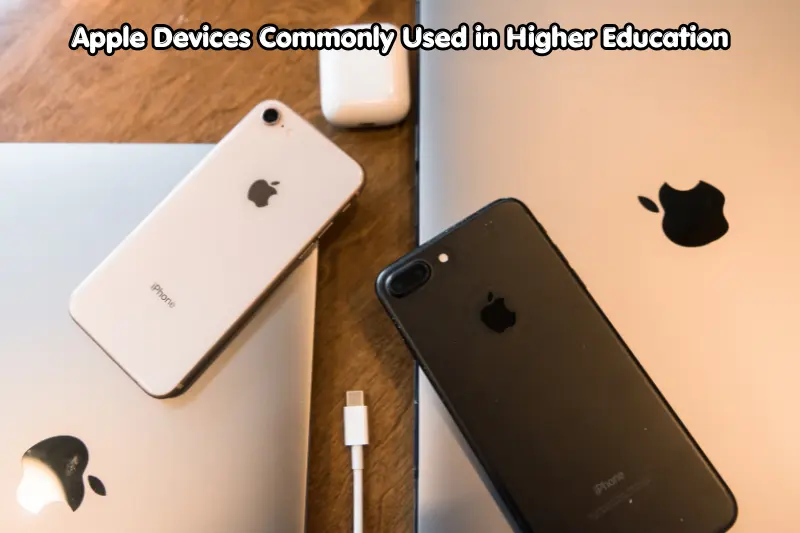
Apple higher education does not depend on one single device. The right choice depends on the course, software requirements, budget, and institutional setup.
Mac
Mac can be useful for students who need a full computer environment for writing, research, coding, design, media production, and professional applications. Apple’s current higher education materials position Mac as a core campus device with performance, battery life, and compatibility with software used by students, faculty, and staff.
iPad
iPad can be useful for reading, handwritten notes, presentations, visual learning, creative projects, and mobile study. With Apple Pencil and compatible apps, students can combine handwriting, documents, diagrams, and multimedia in one workflow.
iPhone
An iPhone can support communication, calendars, authentication, research, photography, recording, and access to learning services. It is generally a companion device rather than a replacement for every type of university computer.
Apple Higher Education Pricing and Eligibility
Education pricing can make Apple products more accessible to eligible students and educators, but the rules depend on the country or region.
For example, Apple’s U.S. education store states that eligible higher education faculty, staff, students, accepted students, and certain parents can qualify for education pricing. Apple’s terms also explain that eligibility and purchasing rules apply to specific education categories.
Because eligibility varies by market, students should check the Apple Education Store for their own country before assuming a discount applies.
Institutions may also have separate purchasing arrangements. Apple’s institution store provides a way for eligible organizations to access institution-specific purchasing options.
How Universities Can Use Apple Higher Education
Apple higher education can be used in several practical ways:
- Student laptops for everyday coursework
- iPads for notes, presentations, and interactive learning
- Mac labs for specialized academic software
- Faculty devices for teaching and research
- Digital creative labs for media and design
- Coding environments for computer science courses
- Device management for IT departments
- Professional learning for educators
- Accessibility tools for different learning needs
- Collaboration tools for group projects
The best setup depends on the university’s courses, software requirements, existing infrastructure, budget, and support capacity.
Apple Higher Education and Campus Management
Technology adoption is not only a purchasing decision. A university must think about deployment, account management, technical support, updates, security, repairs, and replacement cycles.
Apple provides education deployment documentation and Apple School Manager resources for organizations managing Apple devices.
A practical campus plan should define who manages devices, how students receive support, how accounts are created and protected, and how lost or damaged devices are handled.
Apple Higher Education for Students: Simple Tips
Students can get more value from Apple technology by building simple habits.
First, keep files organized by course and semester. Second, back up important academic work. Third, keep software updated. Fourth, use strong account security and never share passwords. Fifth, learn the apps required by your course instead of installing too many unnecessary tools.
Apple’s college resources also provide educational content and videos designed to help students learn more about using Mac and iPad.
Apple Higher Education for Faculty: Practical Tips
Faculty members can start with the academic task rather than the device.
For example, a teacher might use an iPad for handwritten explanations, a Mac for preparing course material, and collaboration tools for group activities. Professional learning can help educators discover better workflows and make technology more useful in daily teaching.
Apple’s higher education program includes resources, tutorials, forums, Apple Learning Coach, and professional learning support.
Accessibility and Inclusive Learning
Accessibility is an important part of modern education. Students can have different ways of reading, writing, hearing, seeing, communicating, and interacting with technology.
Apple provides built-in accessibility features across its products, and its education materials emphasize technology designed for different learners.
Universities should evaluate accessibility based on the actual needs of their students and the requirements of their academic programs.
Real-World University Examples
Apple publishes higher education success stories involving universities in several countries. Its examples include Chitkara University and Galgotias University in India, Sheridan College in Canada, Phuket Rajabhat University in Thailand, San Diego State University, the University of Nebraska-Lincoln, and other institutions.
These examples show different uses of Apple technology, including creative work, science and technology education, athletics, app development, and student learning.
Such examples can provide ideas, but every university should evaluate technology according to its own academic goals and infrastructure.
Things to Consider Before Choosing Apple Technology
Apple higher education can offer useful tools, but a university should look at the complete picture before making a technology decision.
Consider these questions:
- Which software do students and teachers need?
- Are existing systems compatible with the chosen devices?
- What is the total cost of ownership?
- Who will provide technical support?
- How will devices be managed?
- What security policies are required?
- What accessibility features are needed?
- How will devices be replaced or repaired?
- Can students use the same tools at home and on campus?
A good technology plan considers academic requirements first and hardware second.
Apple Higher Education vs. Traditional Computer Labs
Traditional computer labs can still be useful, especially for courses that require specialized software or powerful hardware. However, personal devices can give students more flexibility because they can work outside scheduled lab hours.
Apple higher education can complement campus labs rather than automatically replacing them. A university may use a mixture of personal devices, shared labs, specialized workstations, and mobile technology.
The right approach depends on the institution’s courses and resources.
The Future of Digital Learning
Higher education is becoming more digital, and students increasingly need technology skills that connect with future workplaces. Cloud services, artificial intelligence, creative software, coding, digital collaboration, and mobile learning are becoming part of many academic workflows.
Apple higher education is one part of this wider transformation. The most important goal is not simply owning modern devices. The goal is creating learning environments where technology helps students research, create, communicate, solve problems, and develop useful skills.
Final Thoughts
Apple higher education covers a broad ecosystem of devices, software, learning resources, professional development, deployment tools, and institutional support. For students, it can support study, creativity, coding, research, and collaboration. For faculty, it can support teaching and professional learning. For IT teams, it can provide tools for deployment and management.
The right technology choice should always depend on the university’s academic needs, software requirements, budget, accessibility goals, security policies, and support resources.
When these factors are planned carefully, Apple higher education can become a practical part of a modern digital learning environment rather than simply a device purchasing decision.
Frequently Asked Questions
1. What does Apple higher education mean?
Apple higher education refers to Apple’s products, services, resources, professional learning, and technology solutions designed to support colleges and universities.
2. Can college students get Apple education pricing?
Eligibility depends on the country and Apple’s current education pricing rules. In the United States, eligible higher education students, accepted students, faculty, staff, and certain parents can qualify under Apple’s published terms.
3. Is Mac useful for university students?
Mac can support many academic tasks, including writing, research, coding, presentations, creative projects, and professional applications. However, students should check whether the software required by their specific course is compatible before purchasing.
4. Can universities manage Apple devices centrally?
Yes. Apple provides Apple School Manager and education deployment resources that help institutions manage and deploy supported Apple devices.
5. Does Apple support faculty professional learning?
Yes. Apple provides an Education Community, learning resources, tutorials, forums, and Apple Learning Coach to support educators and digital learning specialists.